
Yes, you absolutely can see an online doctor for a yeast infection. In many cases, you can get a diagnosis and have a prescription sent to your pharmacy within just a few hours. It’s a discreet and incredibly convenient way to handle the classic, uncomplicated symptoms of a yeast infection right from home.
When to See an Online Doctor for a Yeast Infection
Trying to decide between a telehealth service and an in-person clinic visit can feel tricky, but it really comes down to one thing: your specific symptoms. For most women, consulting an online doctor for a yeast infection is a safe, fast, and effective path to relief.
Telemedicine is a perfect fit for those times you recognize the tell-tale signs of a yeast infection you've had before.
Classic Symptoms Ideal for a Virtual Visit
If what you're experiencing lines up with a typical yeast infection, a virtual consultation is an excellent choice. These are the signs an online provider can confidently diagnose and treat without needing a physical exam:
- Vaginal Itching and Irritation: This is usually the most common and maddening symptom. It can be mild or intense and affects both the vulva and vagina.
- Thick, White Discharge: The classic indicator is a discharge that’s odorless and looks a lot like cottage cheese.
- Redness and Swelling: You might notice some visible inflammation of the vulva.
- Burning Sensation: This discomfort often rears its head during urination or sex.
This flowchart helps visualize the two main care paths. It boils down to whether your symptoms are typical or more severe.
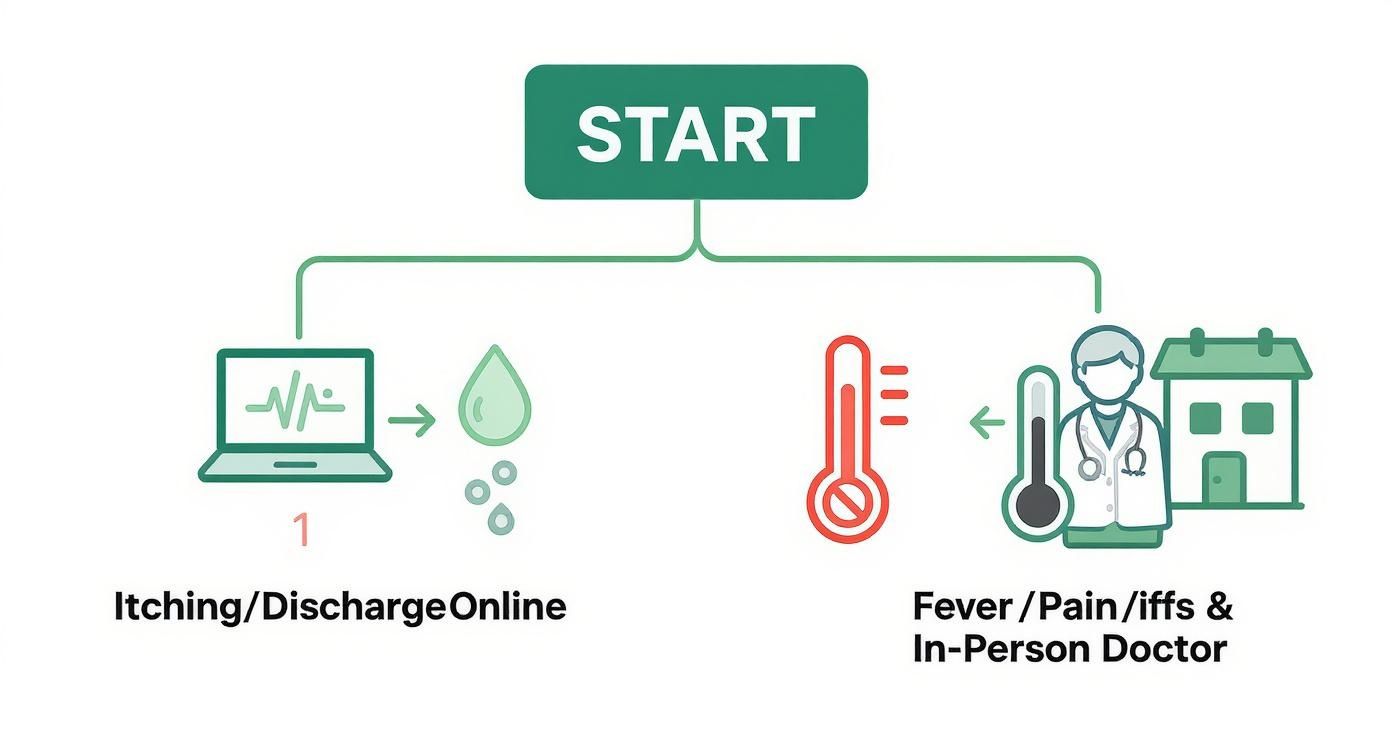
The key takeaway is that standard symptoms like itching and discharge are perfectly suited for telehealth. More alarming signs, however, require an immediate in-person evaluation to be safe.
Red Flags Requiring an In-Person Doctor
While online care is a game-changer for convenience, it isn't always the right move. Certain symptoms can point to a more serious condition that requires a hands-on physical examination, and possibly some lab tests.
Your safety always comes first. If you experience any severe or unusual symptoms, don't use a telehealth service. Instead, seek immediate in-person medical attention to rule out more complex issues.
You should book an appointment with a local doctor or explore your options for online urgent care if you're dealing with any of these:
- High Fever or Chills: These are not symptoms of a simple yeast infection and could signal a more widespread infection that needs immediate attention.
- Severe Abdominal or Pelvic Pain: Intense pain is a major red flag that has to be evaluated in person.
- Foul-Smelling Discharge: A strong, fishy, or otherwise unpleasant odor usually suggests bacterial vaginosis (BV) or another type of infection, not yeast.
- Recurrent Infections: If you've had four or more yeast infections in a single year, you need a comprehensive in-person evaluation to figure out what's going on.
Online Visit vs In-Person Care Which Is Right for You
Still not sure which route to take? This quick comparison table can help you decide on the best care path based on your specific symptoms.
| Symptom or Situation | Good for Online Doctor | Requires In-Person Visit |
|---|---|---|
| Mild to moderate itching & irritation | ✔️ | |
| Odorless, white, "cottage cheese" discharge | ✔️ | |
| You've had a yeast infection before | ✔️ | |
| First-time yeast infection | ✔️ | |
| Severe pelvic or abdominal pain | ✔️ | |
| Fever or chills | ✔️ | |
| Foul-smelling or colored discharge | ✔️ | |
| Four or more infections in one year | ✔️ | |
| Pregnant or have a weakened immune system | ✔️ |
Ultimately, listening to your body is key. If your symptoms feel "off" or more severe than a typical yeast infection, it's always better to err on the side of caution and see a provider in person.
Getting Ready for Your Virtual Consultation
To make your online doctor’s visit for a yeast infection as smooth and effective as possible, a little prep work goes a long way. When you’re ready, the provider can get you an accurate diagnosis—and relief—that much faster. Think of it as organizing your thoughts before you even start the intake process.
The good news is, getting ready is simple. The entire system is built for convenience, and you can see a full breakdown of how it works to get a better sense of the flow. Your main job is just to have the key details on hand.
Pull Together Your Symptom Details
In a virtual setting, the doctor relies completely on what you tell them. Being specific is everything. Vague answers can make it tough to nail down a diagnosis, so before your visit, try jotting down a few notes.
- Symptom Timeline: When did the itching, burning, or weird discharge actually start? Has it been consistent, or does it come and go?
- What You’ve Already Tried: Have you used any over-the-counter creams like Monistat or tried other home remedies? Be specific about what you used and if it helped at all (or made things worse).
- The Nitty-Gritty Details: This is the important part. Be ready to describe the discharge—its color and consistency—and how intense the itching or burning feels. Is the irritation more internal or external? Or both?
Having these answers ready helps the doctor build a clear clinical picture, which is crucial when they can't do a physical exam.
Pro Tip: Don't be embarrassed to get descriptive. Details like "thick, white discharge that looks like cottage cheese" or "a constant, maddening external itch" give your doctor the exact information they need to get you the right treatment.
It’s no surprise that telehealth for women’s health is booming. Virtual care visits in this area shot up by an incredible 276% from the first to the fourth quarter in a single recent year. This huge shift shows just how many people are turning to online care for sensitive conditions.
Organize Your Practical Information
Beyond your symptoms, a few logistical details will make the final steps—like getting your prescription—completely seamless.
Make sure you have this info ready to go:
- Your Current Medications: Jot down everything you take, including prescriptions, over-the-counter meds, vitamins, and supplements. This is for checking any potential drug interactions.
- Known Allergies: Any allergies to medications? Especially antifungals? This is a must-share.
- Your Go-To Pharmacy: Have the name and address of your preferred pharmacy. The doctor needs this to send your e-prescription right over.
- Payment Method: Keep your credit/debit card, HSA, or FSA card handy for the consultation fee.
Finally, find a quiet, private spot where you can fill out the intake form and communicate without being interrupted. A few minutes of prep ensures you can get from consultation to relief as quickly as possible.
So, What Really Happens During an Online Doctor Visit?

Stepping into a virtual consultation for the first time can feel a bit strange. You might be wondering, "How can a doctor really know what's wrong without a physical exam?" It's a fair question. The truth is, the process is surprisingly thorough and relies on a detailed, structured conversation.
Unlike a traditional office visit, there's no waiting room. With a platform like ChatWithDr, you'll kick things off by filling out a secure intake form. Think of it as the digital version of the chat you'd have with a nurse or doctor before they even start an exam. This is your chance to share all the details you prepared—your symptoms, how long they've been going on, and anything you've already tried for relief.
The Diagnostic Conversation
Once you've submitted your information, a board-certified physician will review everything. The whole consultation happens through secure messaging, so you can respond whenever works for you—no need to be on a video call at a specific time. The doctor’s main goal is to build a clear clinical picture based on your words alone.
They'll likely ask some very specific questions to rule out other potential issues and zero in on a diagnosis. Be ready for things like:
- "On a scale of 1 to 10, how intense is the itching?"
- "Can you describe the color and consistency of any discharge?"
- "Have you noticed any particular odor?"
- "Are you having any pain in your abdomen or pelvis?"
Your answers are the key here. For instance, telling them you have "thick, white, odorless discharge" is a classic sign that points straight to a yeast infection. But if you mentioned a "fishy odor," the doctor would immediately start thinking about bacterial vaginosis instead. It's this careful, targeted questioning that allows for an accurate diagnosis from a distance.
This approach is becoming the new normal as healthcare evolves. In fact, the market for yeast infection diagnostics—which powers this type of online treatment—is already valued at $470.5 million and is set to grow. You can dive deeper into the data on point-of-care diagnostics to see how technology is reshaping women's healthcare.
Discussing Your Treatment Options
Once the doctor is confident it's a yeast infection, the conversation will shift to treatment. They'll take your health history, any previous infections, and the severity of your current symptoms into account to map out the best plan of action.
The most important outcome of your virtual visit is a personalized treatment plan that is both safe and effective. Your doctor will weigh the pros and cons of different medications based on your specific situation.
Usually, you'll be looking at one of two main options:
- Prescription Antifungal Pills: For many people, a single-dose oral medication like fluconazole (the generic for Diflucan) is the go-to. It’s powerful, super convenient, and typically clears up the infection fast.
- Topical Antifungal Creams or Suppositories: If you have a milder case or just prefer a topical treatment, the doctor might suggest a strong over-the-counter (OTC) cream or even prescribe something more potent, like terconazole.
The doctor will walk you through their recommendation and answer any questions you have. As soon as you agree on a plan, they'll send the prescription electronically to your preferred pharmacy. It's a fast track to feeling better, without ever leaving your home.
Getting Your Prescription and Starting Treatment
Once your online doctor confirms you have a yeast infection, getting relief is the top priority. This is where telehealth really shines. The whole process is designed to be incredibly fast and simple, connecting your diagnosis directly to your treatment.
The magic behind this speed is e-prescribing. It's a secure digital system that lets your provider send your prescription straight to the pharmacy of your choice. During your intake, you'll be asked where you want to pick it up. It could be a big chain like Walgreens or CVS, your local neighborhood pharmacy, or even the one inside your grocery store—whatever works best for you.
How E-Prescribing Works
After your doctor wraps up your treatment plan, they'll electronically send the prescription over. It’s an instant process. In many cases, your medication is ready for pickup in just an hour or two. That’s a huge step up from waiting for a traditional doctor's office to call it in.
To make sure your pickup is a breeze, here are a few practical tips I always share:
- Give a Quick Call: Before you head out, call the pharmacy to confirm they've received the e-prescription. It’s a simple step that can save you a wasted trip.
- Check Their Hours: Double-check that your pharmacy will be open when you plan to go.
- Don't Forget Your ID: You'll almost certainly need a photo ID to collect your prescription, so have it handy.
This direct-to-pharmacy system is one of the biggest perks of using an online doctor for a yeast infection. It cuts out the middle steps and gets you on the road to recovery faster.
Pro Tip: When you're at the pharmacy, ask if they can check the price with a discount service like GoodRx. Sometimes, even if you have insurance, these apps can find a better price and save you a few bucks on your treatment.
The entire system is built for convenience. If you want to dive deeper into the types of treatments a doctor might prescribe, you can learn more about getting an online prescription and what the process looks like. This seamless path from virtual diagnosis to local pickup means you can often start treatment the very same day you felt symptoms, helping you get back to normal without the hassle.
Understanding Costs, Insurance, and Privacy
When you're dealing with the misery of a yeast infection, the last thing you want to do is navigate confusing medical bills or worry about your privacy. The good news is that reputable telehealth platforms are built to be upfront about both. You should have a clear picture of what everything costs before you even start.

The convenience of seeing an online doctor for a yeast infection usually comes with a refreshingly simple price tag. Many services, like ChatWithDr, charge a single flat fee for the consultation. This often makes it a much more predictable—and sometimes cheaper—option than a traditional doctor's visit, especially if you’re uninsured.
Breaking Down the Cost of an Online Visit
Telehealth pricing is typically very transparent. You’ll know the exact cost of the consultation before pulling out your wallet. This fee covers the doctor's time to review your symptoms, make a diagnosis, and outline a treatment plan just for you.
Let's look at the two most common payment situations:
- Paying Without Insurance: You'll pay a flat fee for the entire visit, which is often a fraction of the out-of-pocket cost for urgent care. For instance, a platform might charge a single, all-inclusive fee of $39.99.
- Paying With Insurance: While many platforms don't bill insurance directly for the consultation itself, you can almost always use your HSA (Health Savings Account) or FSA (Flexible Spending Account) card to cover the fee. Your insurance then kicks in at the pharmacy to help with the cost of any prescribed medication.
The global market for yeast infection treatments is massive, valued at $4.33 billion and expected to hit $4.62 billion this year. This just shows how common these infections are and why having easy, accessible treatment options is so critical. You can learn more about the global yeast infection treatment market and its growth.
The true value of an online visit goes beyond the consultation fee. When you factor in the time you save by not commuting, sitting in a waiting room, or taking a day off work, telehealth is often the most economical and efficient choice by a long shot.
How Your Privacy Is Protected Online
Talking about personal health issues requires a huge amount of trust. Any legitimate telehealth service operates under the exact same strict privacy laws as your family doctor's office. It’s all governed by a federal law called the Health Insurance Portability and Accountability Act (HIPAA).
A HIPAA-compliant platform is legally bound to keep your personal health information secure and confidential. This means every message, every form you fill out, and every medical record is encrypted and protected. Before you use any online doctor service, look for a clear statement on their website confirming they are HIPAA-compliant. This is your guarantee that your sensitive health data is safe, allowing you to be completely open with your provider—which is the key to getting an accurate diagnosis.
Got Questions About Online Yeast Infection Care? We Have Answers
Switching to telehealth for something personal can feel a bit uncertain at first. When you're dealing with the discomfort of a possible yeast infection, you just want clear, straightforward answers so you can get treated and feel better.
We've gathered some of the most common questions people have about getting care online. Let's clear up any confusion so you can move forward with confidence.
Can An Online Doctor Prescribe Diflucan (Fluconazole)?
Yes, absolutely. This is one of the most common—and effective—treatments out there.
If your symptoms and health history point to a standard yeast infection, online doctors regularly prescribe oral antifungal medications like fluconazole (the generic for Diflucan). During your private, text-based chat, the physician will go over your intake form to make sure it's a safe and appropriate choice for you. Once they've confirmed the diagnosis, they'll send the e-prescription straight to your pharmacy, often in just a couple of hours.
What If My Symptoms Don't Go Away After Treatment?
This is a really important question. If you’ve finished the medication and you’re still not feeling right, it’s a sign that something else might be going on. It's possible you have a more resistant strain of yeast, or it could be another condition entirely, like bacterial vaginosis (BV), which can feel very similar but needs a completely different treatment.
In this case, your best bet is to book an in-person visit with your doctor or a gynecologist. They can do a physical exam and run any tests needed to get a firm diagnosis and get you on the right treatment plan.
Your follow-up is just as crucial as the initial diagnosis. Never hesitate to see a doctor in person if the first round of online treatment doesn't fully resolve your symptoms.
How Do I Know If a Telehealth Platform Is Legit?
Trust is everything when it comes to your health. To make sure you’re using a reputable service, keep an eye out for a few key things:
- HIPAA Compliance: This is non-negotiable. The platform must be HIPAA-compliant, which is the federal law protecting your private health information.
- Licensed Doctors: Check that the physicians are board-certified and licensed to practice in your state. A legitimate platform will make this easy to find.
- Transparent Pricing: A trustworthy service is always upfront about costs. You should know exactly what you’re paying before you ever pull out your credit card.
- Real Patient Reviews: Look for genuine reviews from other people. Positive feedback and high ratings on trusted review sites can tell you a lot about the quality of care you can expect.
Is an Online Visit Cheaper Than Seeing My Regular Doctor?
Often, yes—especially if you don't have insurance. Many telehealth platforms charge a single, flat fee for the consultation, which usually comes in lower than the out-of-pocket cost of an urgent care or doctor’s office visit.
If you do have insurance, your co-pay might be about the same. But don't forget to factor in the hidden savings of an online visit: no money spent on gas, no paying for parking, and no time taken off work. When you add it all up, telehealth is frequently the more affordable and convenient option.
Ready to get fast, discreet care without leaving home? At ChatWithDr, a board-certified U.S. physician can diagnose your symptoms and send a prescription to your pharmacy in as little as an hour, all for a flat $39.99. Start your secure online visit now.