
Let's get straight to it: the fastest way to get rid of a UTI is with antibiotics prescribed by a doctor. While home remedies can take the edge off your symptoms, only antibiotics can kill the bacteria that's causing the infection and stop it from turning into something much worse.
What to Do the Moment You Suspect a UTI
You know the feeling. That first, unmistakable twinge is a clear signal to act—and act fast. The initial burning, the frustratingly frequent urge to go, and that dull pressure in your lower abdomen are classic signs that bacteria have settled in. In this first hour, your goal is simple: get comfortable and get ready for the right treatment.

Your Immediate UTI Relief Action Plan
When a UTI hits, every little bit of relief counts. While you're arranging to see a doctor, you can take some immediate steps to manage the discomfort. This quick-reference table matches your symptoms with what you can do right now to feel better.
| Symptom You Feel | What to Do Right Now | What to Avoid |
|---|---|---|
| Burning and stinging when you urinate | Start chugging water immediately to dilute your urine. Aim for a big glass every hour. | Caffeinated drinks (coffee, tea, soda), alcohol, and acidic juices like orange or grapefruit juice. |
| Constant, urgent need to go (with little output) | Use a heating pad on your lower abdomen to soothe the bladder muscles. | Sugary drinks and artificial sweeteners, which can irritate the bladder and potentially feed bacteria. |
| Dull ache or pressure in your lower belly | Try an over-the-counter urinary pain reliever containing phenazopyridine (like Azo). It specifically targets urinary tract pain. | Spicy foods, which can sometimes worsen bladder irritation for some people. |
Remember, this plan is about managing symptoms, not curing the infection. These are temporary measures to make you more comfortable while you seek the medical treatment you truly need.
Key Takeaway: Symptom relief is great, but it's not a cure. These steps are just a bridge to get you to the real solution: antibiotics from a doctor.
Seek Medical Advice Promptly
Once you’ve started managing your comfort, the next move is the most important one for a fast recovery: contacting a healthcare provider. A UTI needs antibiotics, period. Putting it off gives the infection time to travel up to your kidneys, which can lead to a much more serious condition.
Thankfully, you don't have to sit in a waiting room for hours. You can explore options for online urgent care and connect with a doctor who can diagnose your UTI and send a prescription straight to your pharmacy, often within just a few hours. This is the most direct path to getting the medicine you need to start healing today.
Why Antibiotics Are Your Fastest Path to a Cure
While chugging water and trying home remedies might give you a sliver of temporary comfort, they won’t fix the real problem. Let’s be perfectly clear: the fastest way to treat a UTI is with antibiotics. They are the only thing that can actually kill the bacteria causing the infection.
Thinking you can "flush out" a UTI with water alone is like trying to put out a house fire with a squirt gun. Sure, it might dampen the edges, but it’s not going to stop the source of the blaze. Bacteria multiply like crazy in the urinary tract, and only a targeted medication can shut down their party.
How Antibiotics Get the Job Done
Antibiotics work by going on the offensive, directly attacking the bacterial cells that have set up camp—most often, it’s E. coli. These medications are designed to either tear down the bacteria's cell walls until they burst or block them from multiplying altogether. It's a two-pronged attack that stops the infection in its tracks so your body can finally start to heal.
This is exactly why you often feel a huge sense of relief within just 24 to 48 hours of starting a prescription. The medicine gets to work fast, cutting down the bacterial numbers and easing those awful, painful symptoms.
A few of the go-to, fast-acting antibiotics that doctors frequently prescribe for straightforward UTIs include:
- Nitrofurantoin (Macrobid): This is a top choice for a reason. It concentrates in your urine, delivering a powerful punch right where the infection is happening.
- Fosfomycin (Monurol): Talk about convenient. This is a single-dose powder you mix with water. One and done, and it works fast to knock out the bacteria.
- Trimethoprim/sulfamethoxazole (Bactrim): This one is still in the rotation, but bacterial resistance has become more of an issue. Doctors will typically consider local resistance patterns before prescribing it.
Without this kind of medical intervention, the bacteria are free to continue their march up your urinary tract.
The real danger of putting off treatment isn’t just about being uncomfortable for longer. An untreated bladder infection can easily travel up to the kidneys. That leads to a much more serious and painful condition called pyelonephritis, which can land you in the hospital.
The Problem with the "Wait and See" Approach
Relying on cranberry supplements or over-the-counter pain relievers creates a dangerous window of opportunity for the infection to get much worse. While things like D-mannose might have some preventative benefits, study after study shows they just aren't effective for treating an active infection.
By the time you feel that tell-tale burning, urgency, and pressure, the bacterial colony is already thriving. Waiting just gives it more time to grow, seriously increasing your risk of complications. Getting a prescription is the only proven way to shut down the infection before it escalates. The smartest, safest thing you can do is get a proper medical evaluation for a swift and complete recovery.
How Doctors Pinpoint the Right Antibiotic for You
Getting an antibiotic prescription is a great first step, but getting the right one is the key to feeling better fast. A doctor’s choice isn’t just a wild guess; it’s a careful decision based on a few critical factors designed to knock out your infection without contributing to bigger problems.
Ever wondered why the antibiotic that worked for your friend isn't what your doctor recommended? The main reason is the ever-growing issue of antibiotic resistance. Bacteria are smart and constantly evolving, meaning a drug that was a powerhouse five years ago might not be the best bet in your area today.
Local Resistance Patterns Are a Big Deal
Doctors have a secret weapon called an antibiogram. Think of it as a local report card for antibiotics. It shows which bacteria are causing the most trouble in your community and, more importantly, which drugs are still effective against them.
This data-driven approach helps your provider skip over an antibiotic that local E. coli has already figured out how to beat. By picking a medication with a proven track record in your region, they’re placing a smart bet on what will work for you, right from the start.
Why This Matters: Using local data means you're far less likely to need a second round of different antibiotics. That saves you time, money, and most importantly, days of needless discomfort.
The Go-To Treatments for Simple UTIs
For a standard, uncomplicated bladder infection, doctors usually stick to a handful of trusted "first-line" antibiotics. These are the heavy hitters, known for being safe and highly effective against the most common UTI-causing germs.
Some of the go-to options you’re likely to encounter include:
- Nitrofurantoin (Macrobid): This is often a top pick because it concentrates right in your urine. It delivers a targeted punch to the bacteria where they live, with minimal side effects elsewhere in your body.
- Fosfomycin (Monurol): A convenient and powerful single-dose powder. It’s a great option, especially if remembering to take pills for several days is a challenge.
- Trimethoprim/sulfamethoxazole (Bactrim): While its use has dropped in some places due to resistance, it can still be an excellent choice if local bacteria haven’t built up a defense against it yet.
Researchers are constantly evaluating these drugs to keep treatment guidelines sharp. For example, one recent reanalysis of a clinical trial found that nitrofurantoin had a higher clinical resolution rate by day 28 post-treatment at 70%, compared to 58% for fosfomycin. This just reinforces its role as a super reliable choice. You can see the full study findings on nitrofurantoin and fosfomycin here.
In the end, your doctor pieces the puzzle together—your health history, any allergies, and that all-important local resistance data—to choose the perfect antibiotic to get you back on your feet as quickly as possible.
Getting a UTI Prescription Today
When you're dealing with the constant, burning urgency of a UTI, waiting days for a doctor's appointment just isn't an option. Let's be honest, the fastest way to treat a UTI is to get an antibiotic prescription, and the good news is you can often get one in just a few hours. Modern healthcare has thankfully caught up, offering incredibly direct paths to get the medicine you need without the old-school wait times.
This simple decision tree shows exactly how it works: a quick evaluation that leads directly to the right treatment for a common UTI.
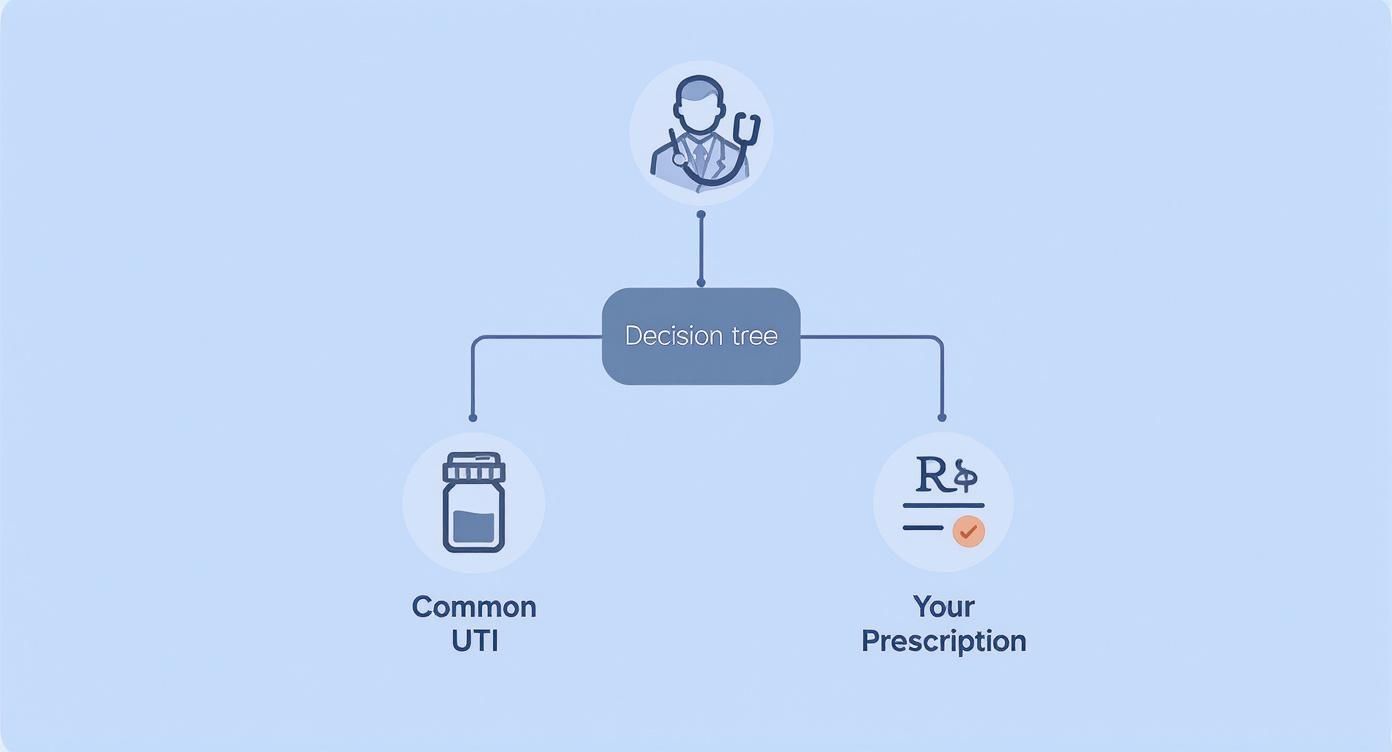
As you can see, a prompt medical consultation is the crucial first step. Your goal is to move from that initial chat to having medication in your hand as quickly and painlessly as possible.
Your Modern Prescription Options
Forget the old routine of calling an office, sitting on hold, and just hoping for a cancellation. Today, you have faster, more convenient choices designed for immediate health needs like a UTI.
Two of the most effective options for same-day treatment are telehealth services and urgent care clinics. Each offers its own set of advantages, depending on your situation.
- Telehealth Services: This is almost always the quickest and easiest route. You can consult with a doctor from your couch, your office, or anywhere you have an internet connection, often through a simple, text-based chat.
- Urgent Care Clinics: A great walk-in option if you'd rather see someone in person or if your symptoms feel more severe. They're built for speed and can handle straightforward issues like UTIs efficiently.
The speed of your visit can even come down to the clinic's back-end operations, like their use of modern and efficient patient charting systems that help doctors move through consultations smoothly.
When you're in pain and need relief fast, knowing your options is everything. Here’s a quick breakdown to help you decide which path is best for you.
Comparing Your Same-Day Prescription Options
| Service Option | Typical Time to Get a Prescription | Key Advantages | Potential Downsides |
|---|---|---|---|
| Telehealth | 1-3 hours | Utmost convenience (no travel), lower cost, private, fast e-prescription process. | Not suitable for severe or complex symptoms, requires internet access. |
| Urgent Care | 2-4 hours | In-person physical exam, can perform on-site urine tests, handles more severe cases. | Longer wait times, higher cost, requires travel, less privacy. |
| Your Primary Doctor | 1-3 days | Doctor knows your full medical history, continuity of care. | Difficult to get a same-day appointment, requires travel, office hour limitations. |
As the table shows, for a straightforward UTI, telehealth is often the clear winner for speed and convenience, getting you on the path to recovery in just a couple of hours.
What to Expect From a Telehealth UTI Consultation
Telehealth has been a total game-changer for treating common infections. The process is remarkably simple and built for speed.
You'll usually start by filling out a secure online form, detailing your symptoms and medical history. It’s the same information you'd give at a doctor's office, but you do it on your own time. A licensed physician then reviews your case, often within an hour or two. For a classic, uncomplicated UTI, a diagnosis can typically be made based on your symptoms alone.
If antibiotics are the right call, the doctor will send an e-prescription straight to your preferred local pharmacy. You’ll get a text or email when it's ready for pickup—no paper script to lose, no extra trips needed. For many people getting an online prescription, the entire process from starting the consultation to having medicine ready can take less than a couple of hours.
Pro Tip: Have your pharmacy’s name and address ready to go when you start your online consultation. It makes the e-prescription process even faster. Some platforms even let you pick your pharmacy from a map right in the intake form.
Ultimately, choosing the right option comes down to your comfort level and how you're feeling. If you have classic UTI signs without complicating factors like a high fever or severe back pain, a telehealth visit is an incredibly efficient choice. But if you feel very unwell or have concerns that need a physical check, an urgent care clinic is your best bet for a fast, in-person assessment. Both paths lead to the same goal: getting you the right antibiotics today.
Making Your Treatment Work Faster
You’ve got the prescription, which is the biggest hurdle cleared. Now, how you handle the next few days can make a huge difference in how quickly you start feeling like yourself again and, more importantly, making sure the infection is gone for good.
The number one rule, and I can't stress this enough, is to finish the entire course of antibiotics. I know it's tempting to stop once you feel better, but this is a classic mistake. Those first few doses knock out the weakest bacteria, but the tougher, more stubborn ones are still hanging around.
When you stop treatment early, you're essentially giving these resilient bacteria a chance to regroup and multiply. This can lead to a relapse that's often much harder to treat the second time around.

Speeding Up Your Recovery While the Antibiotics Work
While the medication is doing its job, there are a few things you can do to support your body and ease that lingering discomfort. Keep chugging water like it's your job. Staying hydrated helps continuously flush your urinary system, which gives the antibiotics a helping hand.
For some immediate relief from the cramping and aching, don't underestimate the remarkable benefits of heat therapy. A simple heating pad or a warm compress on your lower abdomen can work wonders to soothe bladder spasms and take the edge off the pain.
It's interesting how modern medicine is shifting. We used to think longer antibiotic courses were always better, but that's changing. Doctors are now leaning towards shorter, high-impact treatments that are just as effective but carry a lower risk of side effects and antibiotic resistance.
The science is backing this up, too. A 2023 clinical trial showed that for men with UTIs, a 7-day course of antibiotics was just as successful as a 14-day one. The symptom resolution rate for the shorter group was an impressive 93.1%, proving that a more targeted approach works.
When to Check Back In with Your Doctor
You should start to feel a noticeable improvement within 24 to 48 hours after your first dose. The constant urge to go and that awful burning sensation should begin to fade. If two full days pass and you’re not feeling any better—or worse, you feel even worse—it’s time to pick up the phone.
Don't just try to tough it out. Get in touch with the doctor who prescribed your medication. It could mean the specific bacteria causing your UTI are resistant to the antibiotic you’re taking.
If your symptoms aren't improving, here's what to do:
- Don't wait: Contact your doctor right away. They need to know the initial treatment isn't working.
- Be clear: Tell them exactly what's going on. For example, "The burning is just as bad as it was two days ago," or "I've started running a low fever."
- Get new instructions: They'll likely need to switch you to a different antibiotic that can knock out the infection.
A quick follow-up is key. This is where services like a 24/7 telehealth doctor are incredibly valuable, letting you get fast medical advice without having to wait for another appointment. Sometimes, the fastest path to relief involves a quick course correction.
Your Top Questions About Fast UTI Treatment
When you’re dealing with the misery of a UTI, you want answers—fast. Knowing what to expect and what works (and what doesn't) can make all the difference in getting relief quickly and confidently. Let’s clear up some of the most common questions that pop up during treatment.
Right off the bat, everyone wants to know how soon the antibiotics will kick in. You should start to feel a real difference—less burning, fewer frantic trips to the bathroom—within the first 24 to 48 hours of your first dose. Feeling that initial relief is a great sign that the medication is already winning the battle against the infection.
Does Cranberry Juice Actually Help?
Ah, the age-old cranberry juice debate. Here’s the real story: while some research suggests that compounds in cranberries might help prevent bacteria from clinging to your urinary tract walls, it is not a cure for an active infection.
Think of it as a potential helper for prevention if you get UTIs often, but it won't knock out an infection you already have. If you do drink it, make sure it's pure, unsweetened cranberry juice. The sugary cocktail versions can actually irritate your bladder even more. Once you have symptoms, water is your best friend for flushing your system, but only antibiotics will truly cure the infection.
Key Insight: Trying to treat a UTI with cranberry juice is a losing game. It just delays you from getting the medical care you actually need, which can allow the infection to get worse. For a real cure, you need antibiotics.
What if My First Prescription Fails?
It’s incredibly frustrating, but sometimes the first round of antibiotics just doesn't do the trick. This is usually because the particular bacteria causing your UTI happens to be resistant to that specific drug. If you've finished the full course of antibiotics and you're still feeling symptoms—or they come roaring back right after—you need to get back in touch with your doctor right away.
They'll likely want to do a urine culture to pinpoint the exact troublemaker and see which antibiotics will be most effective against it. Don’t see this as a setback; it’s just a smart, targeted approach to make sure you get the right medication for the job.
The good news is that this is becoming less common. A 2023 study found that when doctors choose antibiotics based on local resistance patterns, treatment failures drop significantly. One group in the study saw a failure rate of only 4.57%, a huge improvement over the previously reported 10–18%. You can learn more about optimizing UTI treatment outcomes from the research.
If this happens to you, don't just "wait and see." Calling your doctor for a different prescription is the fastest way to get back on the road to recovery.
Feeling the first signs of a UTI? Don't wait. With ChatWithDr, you can get a diagnosis and prescription from a board-certified U.S. physician in hours, all from your phone for just $39.99. Skip the waiting room and start feeling better faster. Get Treated Now.