

Waking up to a raw, scratchy throat is miserable. The first question that usually pops into your head is, "Is this just a cold, or is it strep?" Knowing the difference is key, and it often comes down to the other symptoms that show up alongside the sore throat.
Strep throat usually skips the classic cold signs like coughing or a runny nose. Instead, it hits you with a sudden, severe sore throat and fever. That distinction is your first big clue that you might be dealing with something more than a run-of-the-mill virus.
Knowing What to Look For: Strep vs. a Viral Sore Throat
That burning, painful feeling when you swallow can be alarming. Is it just a little irritation, the start of a cold, or something that needs a doctor's attention? Figuring out if you have a bacterial infection like strep or a more common viral sore throat is the first step to getting the right treatment.
Viral sore throats, which are way more common, tend to build up slowly. You might feel a little tickle that gets worse over a day or two. It's often joined by a cough, sneezing, a runny nose, and maybe a hoarse voice. These are the tell-tale signs that a virus is the likely culprit.
Strep throat, on the other hand, is caused by Group A Streptococcus bacteria and it doesn’t waste any time. It usually announces itself with a sudden, intense sore throat that can make swallowing feel like you're gulping down sandpaper.
The Telltale Signs of Strep Throat
Unlike a viral infection, strep throat brings a very specific cluster of symptoms. Paying close attention to these signs can give you a much clearer picture of what's going on.
- Sudden and Severe Pain: The sore throat hits you hard and fast, not gradually.
- High Fever: A fever of 101°F (38.3°C) or higher is a common partner to strep.
- Swollen, Red Tonsils: Take a look in the mirror. Your tonsils might be bright red and swollen, sometimes with white patches or streaks of pus.
- Tiny Red Spots: You might also notice tiny red spots (called petechiae) on the roof of your mouth.
- Swollen Lymph Nodes: The glands in the front of your neck may feel tender and swollen to the touch.
Here’s the key takeaway: what's missing is just as important. If you have a nasty cough and a stuffy nose along with your sore throat, it’s much more likely to be a viral illness. The absence of those classic cold symptoms points more strongly toward strep.
To help you sort it out, here’s a quick side-by-side comparison.
Strep Throat vs Viral Sore Throat Symptom Checker
| Symptom | Strep Throat (Bacterial) | Viral Sore Throat (e.g., Cold/Flu) |
|---|---|---|
| Onset of Pain | Sudden and severe | Gradual, starts as a tickle |
| Fever | Common, often high (101°F+) | Can be low-grade or no fever |
| Cough/Runny Nose | Usually absent | Common |
| Tonsils | Red, swollen, may have white spots | Can be red and swollen, but usually no pus |
| Headache | Common | Sometimes |
| Body Aches | Sometimes | Common, especially with the flu |
| Nausea/Vomiting | Possible, especially in kids | Rare |
| Red Spots on Palate | Sometimes present | Absent |
Using this checklist can give you a better idea of what you might be dealing with before you even talk to a doctor.
Recognizing these symptoms isn't just for your own peace of mind. Globally, strep throat is a major issue, causing about 288.6 million sore throat episodes every year in kids aged 5 to 14. You can find more details on the global burden of Strep A in recent studies00523-2/fulltext). This isn't just a simple bug; it's a bacterial infection that needs a proper diagnosis and antibiotics to prevent more serious complications down the road.
Using the Centor Score to Assess Your Symptoms
So, how do doctors quickly figure out if a sore throat is likely strep? Beyond just looking at the symptoms, we often use a handy clinical tool to estimate the probability. It’s called the Centor Score.
Think of it as a methodical checklist that helps us move past pure guesswork. It isn't a diagnosis on its own, but it’s incredibly useful for guiding the decision on whether a strep test is actually necessary. You can use the exact same logic at home to get a much clearer picture of what's going on.
Breaking Down the Five Criteria
Let's walk through the five points of the Centor score. This is all about looking for specific, tangible signs that point more toward a bacterial infection and less toward a common virus.
-
No Cough: This one’s simple. If you have a nasty cough along with your sore throat, you don’t get a point here. The absence of a cough is what makes strep more likely.
-
Swollen, Tender Lymph Nodes: Gently feel the front of your neck, right below your jawline. Are the glands there swollen? Do they feel tender or even painful when you press on them? If so, add a point.
-
Fever Over 100.4°F (38°C): Don't just guess—grab a thermometer. A documented fever is a classic sign that your body is fighting something more aggressive, like a strep infection.
-
Tonsil Issues (Exudates or Swelling): This one requires a quick look in the mirror with a flashlight. You’re looking for white spots, streaks of pus, or just really significant swelling on your tonsils.
-
Age: Strep is most common in kids and less so in adults. Because of this, the score is adjusted. Patients aged 3-14 get a point, while those 45 or older actually have a point subtracted.
This diagram gives you a great visual of how these symptoms can point you in the right direction.
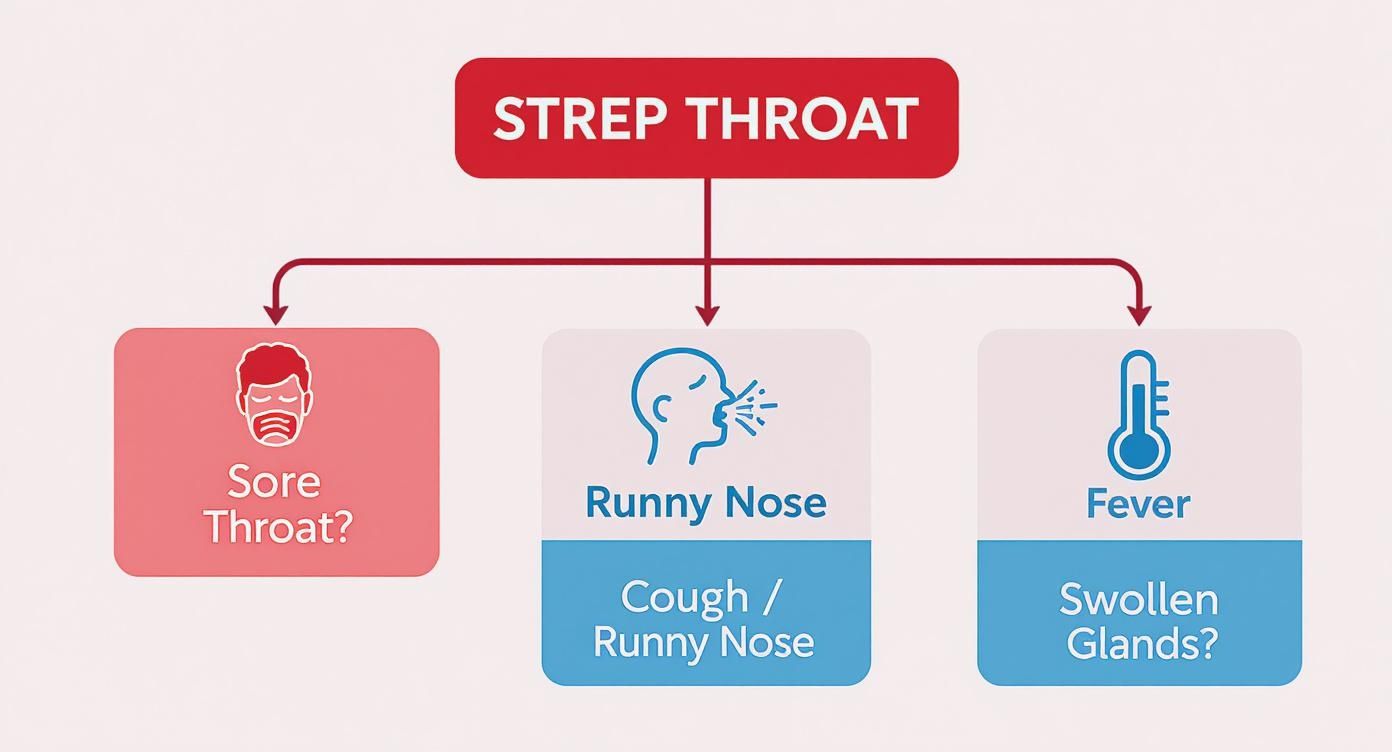
As you can see, when you have a fever and swollen glands but no cough, the odds of it being strep start to climb pretty quickly.
Interpreting Your Score
Once you’ve added it all up, the score gives you a strong hint about what to do next.
A higher Centor score, typically 3 or more, is a strong signal that a rapid strep test or a culture is a good idea. On the flip side, a low score of 0 or 1 means strep is highly unlikely, and you’re probably just dealing with a virus.
Let’s say you have a fever, those nasty white spots on your tonsils, and tender glands in your neck, but you aren’t coughing. That’s a score of 3. In that scenario, getting a professional evaluation is definitely the right move.
This kind of clinical logic helps you understand how to know if you have strep throat with more confidence, so you can decide when it’s truly time to reach out to a doctor.
Getting a Definitive Diagnosis from a Doctor
Self-assessment tools are a great starting point, but they’re no substitute for a professional medical opinion. To really know if you have strep throat and get the right treatment, you need a definitive diagnosis from a doctor. Guessing games can lead to taking antibiotics when you don't need them or, even worse, leaving a bacterial infection to run rampant.
When you see a healthcare provider, they’ll almost certainly start with a quick and simple throat swab. This just means they'll rub a long cotton swab on the back of your throat and tonsils to grab a sample. It’s a little uncomfortable and might make you gag for a second, but it’s over in a flash.
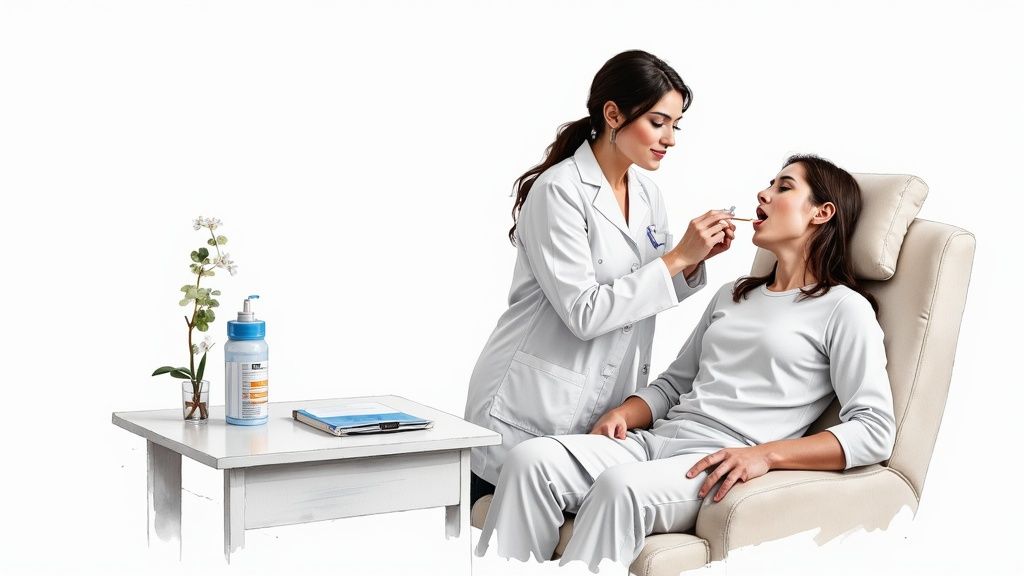
That little sample is the key, and it’s used for one of two tests.
Rapid Antigen Test vs. Throat Culture
The first line of defense is usually the rapid antigen detection test (RADT). This test is designed to look for specific proteins (antigens) that are unique to the strep bacteria.
- Speed: The biggest win here is speed. You’ll have results in just 10–15 minutes, often before you even leave the doctor's office.
- Accuracy: If the test comes back positive, it's very reliable. The catch is that rapid tests can sometimes produce false negatives—meaning the test says you're clear even when you actually have strep.
If your rapid test is negative but your symptoms are screaming "strep throat," your doctor isn't going to just send you home. They’ll likely order a throat culture, which is considered the gold standard for accuracy.
A throat culture uses the same kind of swab, but it's sent to a lab where technicians try to grow Group A Streptococcus bacteria from the sample. It's much more sensitive than the rapid test, but you'll have to wait 24–48 hours for the results.
Strep A is no small matter. Globally, an estimated 1.8 million new infections occur each year, leading to over 500,000 deaths. In the U.S. alone, it accounts for more than 5 million outpatient visits annually. Having access to accurate tests like RADTs and cultures is critical, though this can be a challenge in many parts of the world, as detailed in this STAT News article on the global impact of Strep A.
Knowing how the diagnostic process works can help you know what to expect. If you'd rather skip the waiting room, you can book an online consultation with a licensed doctor to get a fast, convenient evaluation from home and figure out the best next steps for your care.
Red Flag Symptoms and When to Seek Medical Care
Knowing when a sore throat is just a nuisance versus a sign of something more serious is key. Most of the time, it's a virus that just needs to run its course. But sometimes, specific symptoms are your body’s way of saying it’s time to stop the wait-and-see game and get a doctor involved.
A good rule of thumb is to seek medical advice if your sore throat is unusually severe or hangs on for more than 48 hours without getting any better. Another big one is a stubborn high fever—anything at or above 101°F (38.3°C) that isn't budging with over-the-counter meds like Tylenol or ibuprofen. That’s often a clue that you might be dealing with a bacterial infection.
Urgent Signs You Cannot Ignore
Beyond the usual reasons to call your doctor, there are some "red flag" symptoms that demand immediate attention. If you or your child has any of these, it could mean the infection is getting worse or spreading, and you need to act fast.
- Difficulty Breathing: Any feeling of breathlessness or hearing noisy breathing is an emergency. Don't wait.
- Trouble Swallowing: We're not talking about the typical ouch-when-you-swallow pain. This is when it's so difficult you're drooling or can't even swallow your own saliva. Get help right away.
- A Spreading Rash: If you see a fine, red rash that feels like sandpaper and is spreading across the body, it could be scarlet fever, a complication of strep throat.
- Signs of Dehydration: Be on the lookout for dark or infrequent urine, a super dry mouth, and sunken eyes. If you can’t keep any liquids down, you need medical support to avoid dehydration.
The point isn't to scare you, but to arm you with the knowledge of when to act. Waiting too long can open the door to complications. A quick evaluation from a professional can make all the difference in getting you back on your feet safely.
Why Prompt Attention Matters
Recognizing these symptoms has become even more critical lately. After the COVID-19 pandemic, health experts noticed a significant global spike in severe and invasive Group A Strep infections. For instance, the UK saw a concerning rise in invasive cases and even related deaths in children, which really drove home how important it is to be vigilant. You can learn more about the global insights into this surge and see why experts stress early diagnosis.
If any of these red flags pop up, don't hesitate. For urgent—but not life-threatening—issues, telehealth is a fantastic way to get a professional opinion without leaving your couch. You can describe what's going on with a licensed physician and get a game plan quickly, which is a lifesaver when you're feeling too sick to go anywhere.
Navigating Your Strep Throat Treatment Plan
So, you’ve got a confirmed case of strep throat. The good news is that the path to recovery is pretty straightforward. A positive strep test means it's time for antibiotics to knock out the Group A Streptococcus bacteria causing all that misery.
Taking antibiotics isn't just about feeling better faster. It’s about completely eliminating the infection. This is a critical step in preventing some rare but serious complications, like rheumatic fever, which can unfortunately lead to permanent heart damage. It’s the main reason doctors are so proactive about treating strep.
The Golden Rule of Antibiotics
If you remember only one thing about your treatment, make it this: finish the entire course of your prescribed antibiotics. This is non-negotiable.
You’ll probably start feeling a lot better within a day or two, and it can be tempting to stop taking the pills. Don't. Stopping your medication early is a classic mistake that allows the toughest, most resilient bacteria to survive. This can lead to the infection coming right back or, worse, contribute to the growing problem of antibiotic resistance.
Getting an online prescription for strep throat can get your treatment started fast, but it’s entirely up to you to see it through to the end.
Think of it like this: The first few days of antibiotics wipe out the weakest bacteria, which is why your symptoms improve so quickly. But the full course is what’s needed to hunt down and eliminate the strongest survivors, ensuring the infection is truly gone for good.
At-Home Care for Symptom Relief
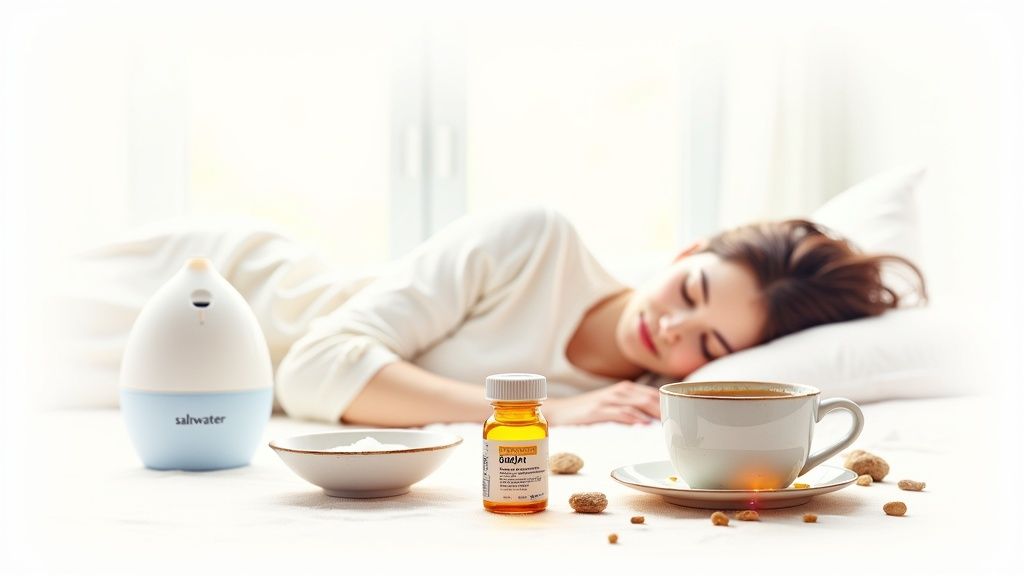
While the antibiotics get to work on the bacterial front, you’ll still need to manage the symptoms. Think of your medication as just one part of the equation; good at-home care makes the whole recovery process far more comfortable.
Here are a few practical things you can do for some real relief:
- Stay Hydrated: Swallowing might feel like a chore, but your body needs fluids. Cool water, ice chips, or warm (not hot!) decaf tea with a bit of honey can feel incredibly soothing.
- Gargle with Salt Water: It's an old-school remedy for a reason—it works. Just mix about a half-teaspoon of salt into a glass of warm water, gargle for 30 seconds, and spit. This helps reduce swelling and cleanses your throat.
- Use a Humidifier: Dry air is your enemy when you have a sore throat, especially at night. A cool-mist humidifier in your bedroom adds moisture to the air and can make a huge difference in your comfort level while you sleep.
- Stick to Soft Foods: Now is the time for soups, yogurt, smoothies, and mashed potatoes. Stay away from anything crunchy, spicy, or acidic (like orange juice), as it will only irritate your throat more.
By pairing your prescription with these simple comfort measures, you're giving your body the best possible chance to heal quickly and comfortably.
Get a Fast Strep Throat Evaluation Online
So you've navigated the symptoms and figured out your treatment options. What's next? Getting a professional diagnosis. But let’s be honest, who wants to drag themselves to a clinic and sit in a crowded waiting room when they feel absolutely miserable?
The good news is, you don't have to. You no longer need to rearrange your entire day for a doctor's visit. Telehealth has completely changed the game for common illnesses like strep throat, allowing you to get answers right from your couch.
How Online Urgent Care Works for Strep Throat
The whole process is built for speed and simplicity. You start by filling out a secure online form, describing your symptoms in detail. A board-certified doctor then reviews your case, often within a few hours, and assesses everything against clinical criteria like the Centor score to figure out what’s going on.
This approach is surprisingly effective for straightforward conditions. A physician can often make a strong clinical judgment just by looking at the classic signs—like a high fever and swollen tonsils without a cough.
Imagine this: you get a professional medical opinion, a personalized treatment plan, and a prescription sent to your pharmacy, all without ever needing a video call. This is the new standard for convenient care, getting you on the road to recovery that much faster.
If your symptoms are pointing strongly toward a bacterial infection, the doctor can e-prescribe antibiotics directly to your preferred pharmacy, usually on the same day. Getting started on treatment right away is the key to feeling better fast and stopping the infection from spreading.
You can learn more about how to get same-day online urgent care for strep throat and other common issues. It means no more lost workdays or stressful trips to a clinic when you’re already feeling awful. By using a trusted online service, you can take control of your health and get the care you need, right when you need it most.
Got Questions About Strep Throat? We’ve Got Answers.
Even after you’ve checked all the boxes on your symptom list, you probably still have a few questions rolling around in your head. Let's clear up some of the most common ones people ask about strep throat.
How Long Is Strep Throat Contagious?
Strep is incredibly contagious, which is why it spreads through schools and homes so fast. The good news? You're usually not contagious anymore once you’ve been on antibiotics for at least 24 to 48 hours and your fever is gone. Until then, it’s really important to stay home to keep from passing it on.
Can Adults Get Strep Throat Easily?
Absolutely. While it’s famous for making kids miserable, adults are far from immune. You’re at a higher risk if you’re around children a lot—think parents, teachers, and daycare workers. The symptoms and treatment are pretty much the same for adults as they are for kids.
Here's a common myth I hear all the time: "I can't get strep throat because I don't have tonsils." Unfortunately, that's not true. Even without tonsils, the Group A Streptococcus bacteria can still set up shop and infect the other tissues in your throat.
Can a Doctor Diagnose Strep Throat Without a Test?
An experienced doctor can make a very educated guess based on what they see and by using clinical tools like the Centor score. But at the end of the day, a rapid antigen test or a throat culture is the only way to know for sure.
That said, telehealth doctors are pros at assessing your risk from afar. If your symptoms scream strep, they can often prescribe antibiotics to get you started on treatment right away, saving you a trip to the clinic.
What Happens If Strep Throat Is Not Treated?
This is a big one. Just toughing it out isn't a great idea with strep. Left untreated, it can sometimes lead to some pretty serious complications, like kidney inflammation (post-streptococcal glomerulonephritis) or even rheumatic fever. Rheumatic fever is a major concern because it can cause permanent damage to your heart valves.
This is exactly why getting a proper diagnosis and taking your full course of antibiotics is so critical. Don't cut corners with this one.
Struggling with a nasty sore throat and don't know what to do? ChatWithDr offers fast, easy online consultations with board-certified doctors who can help. You can get a diagnosis and a treatment plan right from home, with prescriptions sent to your pharmacy, often on the same day. Get started with your online consultation now.
